Laser Welding vs Soldering: Which One Belongs on Your Bench?
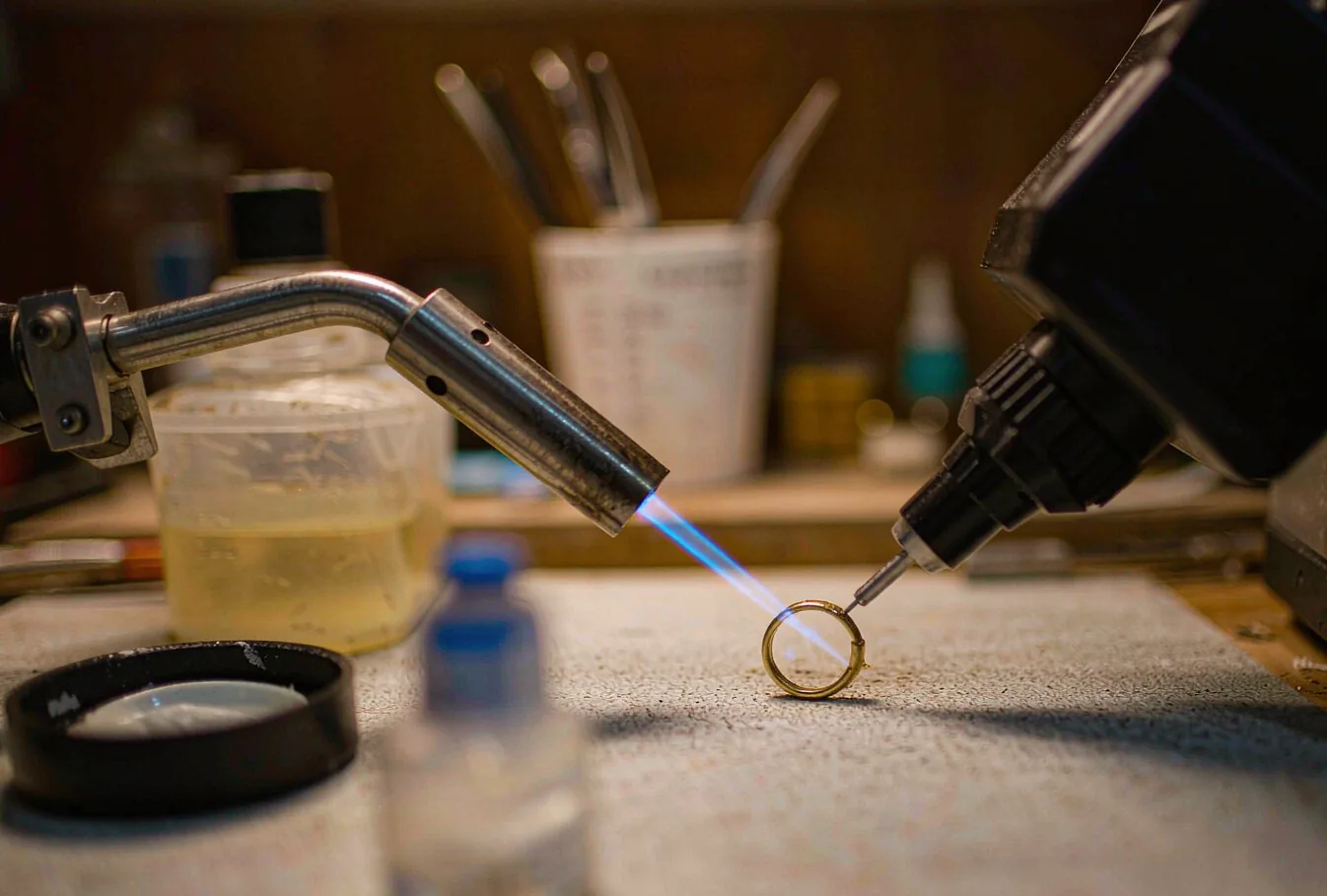
Both methods join metal. They do it in completely different ways, and the shops that understand the difference don’t argue about which is better – they use both, and pick per job.
Two different ways to make one joint
Soldering (properly, brazing) is capillary: you heat the whole workpiece until a third alloy – the solder – melts and flows into the gap. Because that alloy melts lower than the parent metal, it is a different metal, and it shows as a seam and a color line. Laser welding is fusion: a focused 1064 nm pulse melts the parent metal itself, plus matching filler wire if you’re rebuilding material. One piece of the same alloy when you’re done.
The heat-affected zone is the whole story
A torch spreads heat across roughly 3-5 mm around the joint. A laser concentrates it in about 0.1-0.5 mm. That single difference explains almost everything:
- Springs and clips keep their tension – no annealing a whole section to weld one corner.
- Stones can often stay set. Diamonds tolerate heat well; emeralds, opals and pearls do not – but with a laser’s local heat you can retip a prong next to a diamond without pulling it.
- White gold keeps its temper, so you’re not re-hardening after every repair.
- Cleanup drops sharply – less oxidation, less heat shadow, far less polishing to hide the work.
Where the laser clearly wins
Anything near stones. Anything platinum (high melting point, low conductivity, very clean welds). Fine chains, thin shanks, prong rebuilding, porosity in castings, high-value pieces where distortion is unacceptable. If a repair is currently outsourced, or done by pulling stones first, the laser usually pays for itself there.
Where the torch still wins – honestly
Large-area joints and simple structural resizing on plain metal. Bulk work where broad heat is fine. A low-volume shop doing mostly straightforward repairs may not have the throughput to justify a laser at all. A torch setup costs far less up front, and an experienced hand can do beautiful work with it. We’re not going to pretend otherwise.
Cost is per repair, not per machine
The useful comparison isn’t the purchase price – it’s cost per finished job: equipment plus labor plus consumables plus finishing plus rework plus what you outsource. A ring sizing that takes 25 minutes with a torch and unsetting a stone can take under 8 with a laser and no unsetting. If that happens a few times a day, the math tips fast. If it happens twice a month, it doesn’t.
Most good benches end up with both
The strongest repair bench isn’t the one with the newest tool – it’s the one that knows which tool the job needs. Keep the torch for what it’s good at. Bring in the laser for the repairs you currently turn away.
Which repair do you turn away today?
Tell us the jobs you currently refuse or outsource. We will show you the same job done on a laser, on video, so you can judge it on your own work.
CN Laser · Guangzhou Centro South Tech
WhatsApp: +86 185 2016 7321 · Show us your jobs