One machine, a bench full of jobs. This 200W YAG pulse welder earns its keep on jewelry repair and small precision work — here’s what it handles, how each job is actually done, and the honest list of what it isn’t for. Every setting below is a starting direction, not a copy-paste number: your machine, your alloy, and two minutes on scrap will dial it in.
Everyday repair work
Ring sizing
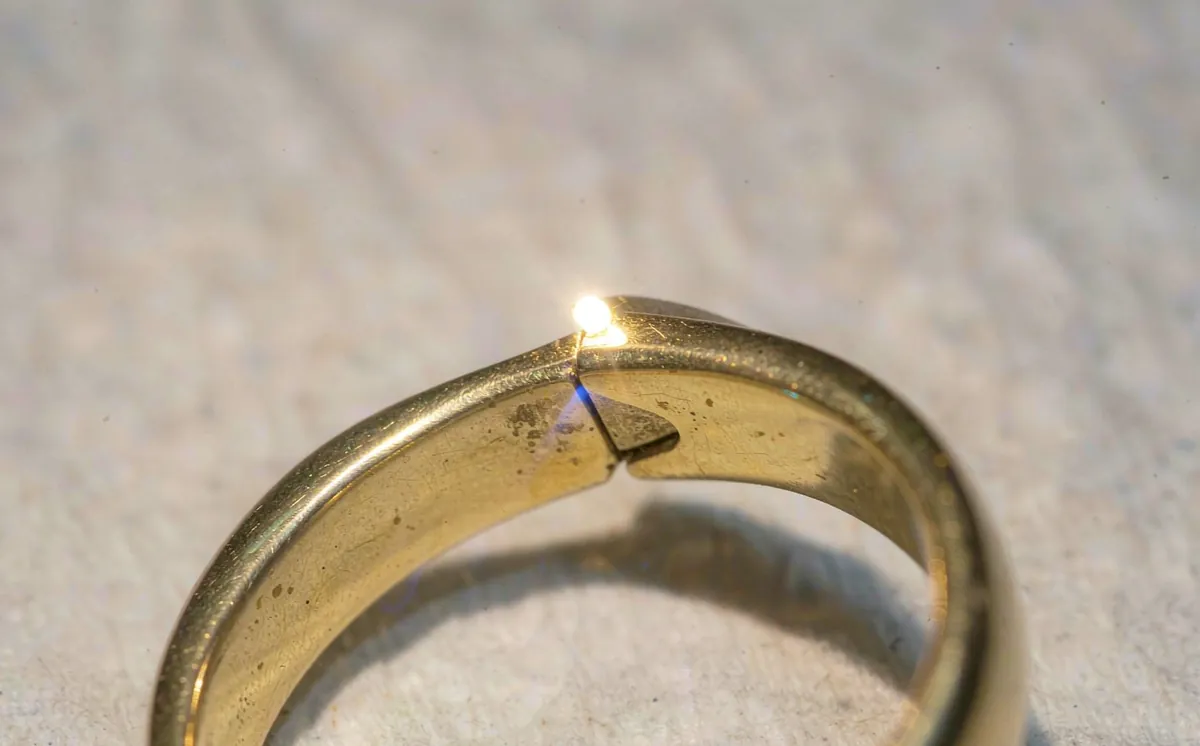
Cut-and-close sizing seams weld with low energy and short pulses, a few tacks around the seam. The weld should sit smooth with no step. If the ring comes out smaller than you measured, you’re running too hot.
Prong and claw repair
Fine spots, gentle pulses, built up in layers. A rebuilt prong ends rounded and the stone stays cool. Keep the heat off the stone — wet cotton or a small heat sink between stone and joint, every time.
Casting porosity
Fill from the outside in, or you trap gas in the middle. On a stubborn hole, open it up first, then fill in layers. Done right, the repair is invisible after polishing.
Chain and delicate links
Thinnest spot, gentle energy — one collapsed link and there’s no fixing it. Very fine chain is honestly easier with a torch; the laser wins where the chain is set or where heat must stay local.
Ear posts and findings
Low energy, tack and hold. Posts are thin — too much heat and you melt the pin. A clean, small, unblackened joint is the mark of the right setting.
Watch and band links
Medium energy with good heat management. Steel and titanium bands discolor fast, so run enough argon — a clean, strong, uncolored seam is the target.
High-value metals
Titanium eyewear frames
Where the laser beats the torch: clean, silver-white welds on beta-titanium frames — if the argon is on the joint before the pulse. Titanium blues the instant it sees oxygen. Low energy, short pulses, gas first. Read the full titanium guide →
Platinum (Pt950)
High energy, longer pulses, slow cool-down. Platinum melts near 1768°C — too little energy gives a false weld, cooling too fast gives cracks. This is where pulse energy earns its keep.
Silver (925)
Small energy, fast placement. Silver reflects light until it melts, so the pulse has to bite, not skate. Honest note: thin silver is often better with a torch — the laser wins on set pieces where heat must stay local. Read the silver guide →
21K and 22K gold
Standard for the Gulf and South Asia. The rule is filler matching: 21K filler on 21K, 22K on 22K — never substitute 18K, the color difference shows immediately. Lower energy than 18K; the alloy is softer.
What this machine isn’t for
Straight talk, because it’ll save you a bad purchase: this is a jewelry and small precision tool, not a general fabrication welder. Heavy steel structures, structural aluminium, thick-section industrial work — that’s a different machine. If your work is mostly that, we’ll tell you honestly and point you in a sensible direction.
Not sure your job fits? Send it to us
Tell us the piece — metal, thickness, whether stones are involved — and we’ll tell you straight whether this machine handles it and what settings to start from. If it’s not the right tool, we’ll say so.
CN Laser · Guangzhou Centro South Tech
WhatsApp: +86 185 2016 7321 · Ask about your application